
**The Concept of Media Lab in the Context of Thai Society**
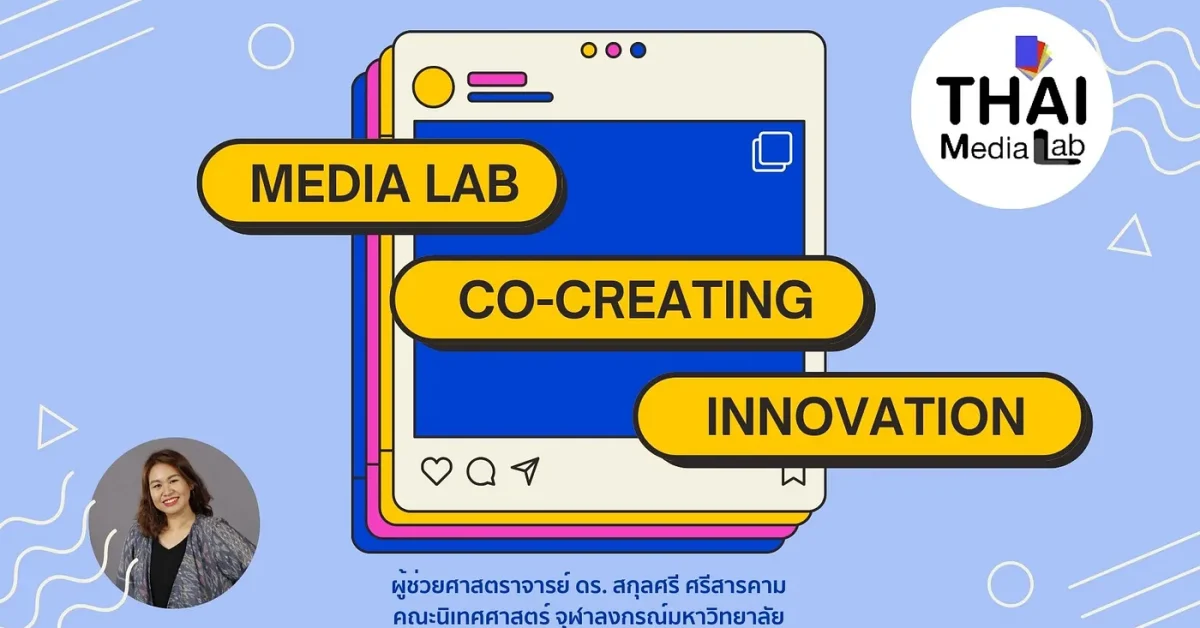
Thai Media Lab is a collaborative network between academics and professionals for conducting research, experimenting, and developing media innovations together. This network started in 2019 when we, as researchers interested in media innovation, studied approaches to promoting media innovation in various countries. We found that one important mechanism is the “Media Lab.”
When hearing the term “Media Lab,” the first thought that likely comes to mind is the MIT Media Lab, a great model from which we can learn. For innovation development to be practically applied, it requires a structure, system, and support from a networked organization to foster true development. However, there are hundreds of Media Labs worldwide, each with different goals and development challenges. What’s interesting is how these labs serve as mechanisms for many countries to use media as a societal solution. Meanwhile, many media organizations abroad have their own Media Labs to innovate in response to changes in the media ecosystem and to find ways to maintain “media quality” in various aspects (I’ll share some lessons from other countries in a future post).
After researching numerous case studies, we asked ourselves, “Amidst all the confusion about the future of media, how will it continue to be relevant in Thai society?” If we were to create a Media Lab mechanism here, what would it look like?
In 2017, Thailand established the Safe and Creative Media Development Fund, a body that provides funding for media development. That year, we started gathering a network and pitching ideas to various researchers, inviting them to help us experiment in building Thai Media Lab together.

**Starting with four universities under the theme “Working with Communities to Create Media Innovations for the Community,” the task that year involved media professors, students, and community members who needed to use media. We experimented with the concept of “Transmedia Storytelling” to explore whether this type of storytelling could become a new communication tool for communities on social issues. The prototypes developed included stories about ethnicity and smoke prevention (Faculty of Educational Administration, Chiang Rai Rajabhat University), community stories from Bang Lamphu and Nang Loeng (College of Innovation, Thammasat University), and Gen Z using transmedia storytelling to drive environmental issues (Faculty of Mass Communication, Ramkhamhaeng University + Communication Arts, Panyapiwat Institute of Management).
From that model, we found that collaborative work with behavioral goals, viewing media production as a tool to “create behavior” for participants, expanded our scope and partners to more than 10 networks the following year. We addressed issues such as “bullying in schools.”
That year, we developed media prototypes that were applied in communities and schools in several provinces (we will expand on this later). We discovered that media innovation does not only involve technology. Rather, it is the “use of media suited to the audience and objectives of each area, creating processes and using them for new challenges = process innovation.” In this process, participants changed their attitudes and behaviors toward bullying. Thus, media became more than just communication—it became a “solution” tool for addressing social issues.
We realized that participation in experimentation from professionals, communities, and academics, supported by funding organizations, designed through an action research process like a lab, can lead to research that isn’t just theoretical but can be practically applied. Media innovations can be used socially.
The following year, we compiled our lessons into a book, **Transmedia Storytelling**, the first Thai-language book on the subject in Thailand. When writing the book, we used the lab process to train and develop skills and extract lessons from that training, creating more easily understandable transmedia storytelling content and practical design guidelines. This made it easier for those interested in using transmedia storytelling as a tool for innovation without needing to rely solely on English-language resources. This knowledge became more widely accessible (you can download the book for free at [link]
In 2023-24, we saw tangible progress in collaboration between academics and professionals in developing work processes and media organization products. Seven prototype teams worked between researchers and media organizations to develop challenges that the media organizations wanted to tackle together. All the results were practical, and there is potential to expand the value creation of products within the media organizations (follow updates in our **Digital Media & Audience Participation Lab** posts).
Ultimately, Thai Media Lab is a space for bringing people together to experiment with media innovations. There are no boundaries in terms of topics, but we share the common goal of developing media innovations to empower those involved in the process and the society where those innovations are applied. In the future, if we can incubate entrepreneurs to generate clear revenue from innovations, the Media Lab process will become even more complete, and we will firmly establish the development of “media as a driver of society” sustainably.